
Blog
Which curriculum should I use for September 2026?
Many teachers have been asking when their teaching needs to reflect the new subject specifications which were published in 2025, and which curriculum to use for planning for September 2026.
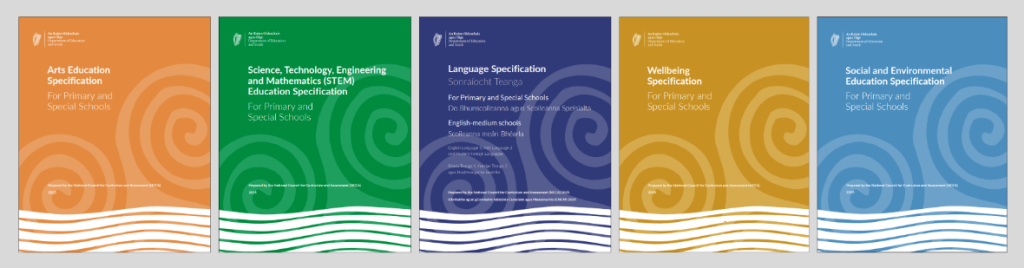
This post aims to clarify the rollout timeline and what it means in practice for planning this coming September.
Key Message: everything is not changing at once
The redeveloped primary school curriculum is being introduced on a phased basis over a number of years, not all at once, as outlined in Circular 0067/2025.

Circular 0052/2026 (published in May 2026), provides more detail:
- Schools will begin the enactment process for at least one curriculum area from September 2026 (Wellbeing, SEE, STEM, Arts Education or MFL).
- Schools can identify the preferred order in which they wish to enact the curriculum areas. However, Wellbeing must be included within the first three areas selected.
- Only one curriculum area will receive focused support from Oide/NCSE during the 2026/2027 school year.
- Oide and the NCSE will communicate with schools in May 2026 regarding the application process for curriculum enactment support for 2026/2027. Circular 0052/2026 states that “Oide will assign a professional learning leader to each school to support a curricular area, taking account of their preferences insofar as possible.” This suggests that schools may not necessarily receive support in their first-choice curriculum area.
- Each curriculum area will take approximately two school years to fully enact.
- From the second year onwards, two curriculum areas will be in progress simultaneously (one in its first year of enactment and another in its second year).
- A new curriculum area will be introduced each year, meaning full implementation is expected to take approximately five to six years.
- From the 2028/2029 school year onwards, schools may opt to take a consolidation year. This allows them to pause for one year to strengthen and embed curriculum areas already in progress.
In my personal opinion, while schools have the option to begin enactment in more than one curriculum area from September 2026, a gradual approach is likely to be more manageable for many schools. Beginning with one area allows staff time to become familiar with the new specification and approaches to teaching, learning and planning, particularly as focused Oide/NCSE support will only be available in one curriculum area during 2026/2027. I would also strongly recommend that schools take the consolidation year which is allowed for.
What does this mean for planning in September 2026?
Circular 0052/2026 confirms that schools will begin enactment of at least one new curriculum area from September 2026. However, the circular does not provide detailed guidance on exactly how schools should approach recorded preparation (planning) during the initial stages of enactment.
As a result, schools may take slightly different approaches depending on their context, readiness, and the curriculum area selected.
For example:
- Some schools may choose to base both long-term and short-term recorded preparation for their chosen curriculum area on the new specification from the beginning of the 2026/2027 school year.
- Other schools may decide to begin enactment more gradually, retaining aspects of the 1999 curriculum in their planning while beginning to incorporate the approaches, concepts and learning experiences outlined in the new specification over the year.
This may also be influenced by:
- the curriculum area selected,
- staff readiness and familiarity with the specification,
- and the availability and timing of Oide/NCSE support.
Outside of the selected curriculum area for enactment:
- English and Irish continue to be based on the Primary Language Curriculum (2019).
- Maths continues to be based on the Primary Mathematics Curriculum (2023).
- Other curriculum areas not yet selected for enactment may continue to use existing planning approaches based on the 1999 curriculum during the phased rollout process.
What curriculum are the long terms on TeachingPlans.ie based on?
For September 2026, the Long-term plan bundles will be based on:
- the 2019 Primary Language Curriculum for English and Irish,
- the 2023 Primary Mathematics Curriculum for Maths,
- and the 1999 Primary School Curriculum for other subjects.
This reflects the phased rollout of the redeveloped primary curriculum, where schools will begin enactment in one curriculum area at a time from September 2026 onwards.
Plans aligned to the new subject specifications are available separately on the website, allowing schools to select the curriculum area they have chosen for enactment.
This approach allows schools to:
- begin the school year with comprehensive, usable long-term plans,
- add planning for their chosen curriculum area for enactment,
- and implement the new specifications gradually in line with the national rollout process.
Why plans for the new specifications are provided separately
As schools will begin enactment with different curriculum areas, it would not be practical to include all new specification plans within a single bundle at this stage.
- Schools will initially enact one curriculum area only.
- Different schools will begin with different curriculum areas.
- Full rollout will take place gradually over approximately five to six years.
For this reason, plans aligned to the new specifications are developed and released separately, allowing schools to access the curriculum area relevant to their own enactment process.
Final Thoughts
The rollout of the redeveloped primary curriculum is a significant change for schools, and it is understandable that many teachers are feeling uncertain about what exactly is required from September 2026.
However, the key point to remember is that implementation is designed to happen gradually, over a number of years.
While schools may take slightly different approaches to enactment and planning during the initial stages, the process is intended to be phased and manageable rather than an immediate whole-school overhaul.
As further guidance and examples emerge over time, schools will continue to refine their approaches to planning, teaching and enactment.
TeachingPlans.ie will continue to develop and update planning resources in line with the phased rollout process, including plans aligned to the new curriculum specifications as schools begin enactment in different curriculum areas.

Do we stay with the 1999 curriculum subject timings?
Hello, Circular 0067/2025, states that “Since the launch of the framework in 2023, schools have had the flexibility to enact the suggested time allocations if they wished.”
Circular 0052/2026, clarifies that “The new suggested time allocations outlined in the Primary Curriculum Framework (2023) should be implemented by all schools by the end of the first curriculum enactment cycle i.e. by the end of the 2027/2028 school year.”
Therefore following the new time allocations is not required yet, however schools may choose to start exploring and experimenting with them now.I have more information on this, as well as a link to a full blog post on it here.