
Blog
NCSE Toolkit for the Deployment of SNA Support (2024): What Teachers Need to Know
The NCSE Toolkit for the Deployment of SNA Support (2024) is the latest version of guidance first issued in 2022. While the original release wasn’t widely publicised, this updated 2024 edition is now being actively referenced by Special Educational Needs Organisers (SENOs), meaning schools need to be familiar with it.
The Toolkit outlines how schools should identify, plan, deploy, and review Special Needs Assistant (SNA) support for students with additional care needs. It brings welcome clarity in some areas, but also introduces additional documentation requirements and tighter criteria that may, in practice, narrow access to SNA support and increase the bureaucratic workload for schools.
Below, I’ve summarised the key updates that I feel are most significant for teachers and school leaders.
1. Stronger Emphasis on Parental and Student Voice
One of the most positive developments is the Toolkit’s focus on meaningful parent and student involvement throughout the entire process of planning care support.
-
Parents’ expertise about their child is to be actively sought and valued.
-
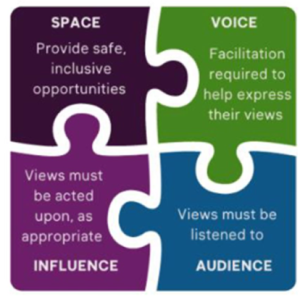
Student voice must be captured in a genuine way, not tokenistically, with reference to the Lundy Model of Participation.
-
For students who are minimally verbal, schools must use alternative communication methods to gather their views.
This shift places the student and family at the centre of the decision-making process, which is an important move towards greater transparency and inclusion.
2. Evidence-Informed and Flexible Deployment of SNA Support
The guidance makes it clear that SNA support should only be provided where a student’s needs cannot be met by other means. Before considering SNA allocation, schools are expected to explore:
-
Whole-school or classroom-level evidence informed interventions,
-
Peer or SET support,
-
Environmental adaptations, and
-
Assistive technology solutions.
This effectively raises the threshold for SNA access, requiring schools to document that all other strategies have been exhausted first.
The Toolkit also stresses that SNA deployment must be flexible and regularly reviewed, with schools tracking how supports are used across the year.
3. A New Template for Care Needs Planning
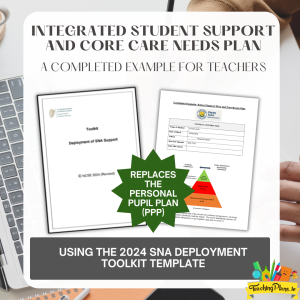
One of the most striking changes is the new Student Support File (SSF) format, which now incorporates Primary Care Support Targets and a mandatory review section.
This replaces the previous Personal Pupil Plan (PPP), and it is significantly more detailed. Schools must document:
-
Long-term care goals,
-
Specific, measurable care targets,
-
The student’s own input,
-
Parent/guardian input,
-
The staff involved and frequency of support, and
-
A review record evaluating progress and next steps.
While this integrated approach is reflective of good practice, it undeniably adds to the administrative workload for schools, as the previous PPP requirements as set out in Circular 0030/2014 were less extensive.
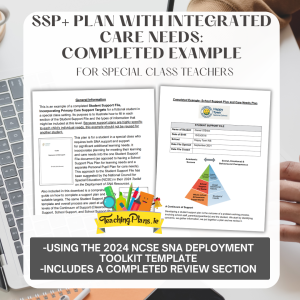
If you’d like to see an example of a Student Support File and care needs planning using the new template, I’ve created two fully completed sample plans (one for a child in a mainstream class and one for a child in a special class) available now on TeachingPlans.ie:
4. Narrower Definitions of “Significant Primary Care Needs”
Perhaps the most consequential change lies in the expanded examples of what does, and does not, constitute a Significant Primary Care Need (pp. 23–26).

While Circular 0030/2014 outlined the main categories, this Toolkit provides detailed, and more restrictive, examples. Several supports that many schools previously included in SNA applications are now explicitly listed as not qualifying.
For example:
-
Scheduled movement breaks and following an OT or sensory programme are not grounds for SNA access.
-
Prompting or reminding a student to use the toilet or eat is insufficient grounds for SNA support.
-
In order to receive support for toileting, students must have an accompanying Toileting Programme.
- The child must have a Feeding Eating Drinking Swallowing (FEDDS) care plan in order for SNA support to be granted because there is a risk of choking. A child who puts too much food into their mouth is not considered to have a significant primary care need under the Feeding category.
- A student Care Plan must be in place for a student to receive support for the administration of medicine.
- Behaviour-related SNA access now requires a formal Behaviour Support Plan to be in place. See below for an example.

5. Increased Record-Keeping Requirements
Schools are required to maintain a Register of Students in receipt of SNA support, similar to how SET access is tracked under the revised allocation model.
This register must record:
-
Each student’s identified care need,
-
The area and type of support provided, and
-
The level of support (whole-school, school support, or school support plus).
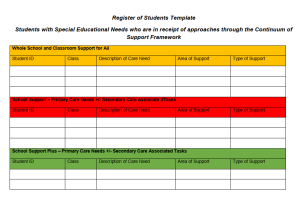
While this brings greater accountability, it represents another administrative responsibility for schools already managing multiple layers of planning and record-keeping.
As mentioned above, schools are also required to have additional plans for students receiving support for toileting (a toileting programme), feeding (FEDDS care plan), administering medicine (a student care plan), and behaviour (Individual behaviour support plan).
6. Focus on Independence and Review
The Toolkit reiterates that SNA support should always aim to foster independence, not dependence. SNAs should be deployed to enable pupils to build skills for self-care, regulation, and participation.
The required review process within the Student Support File should guide future planning and can lead to reorganisation of SNA support as pupils make progress. This aligns well with the principles of the Continuum of Support, though again it formalises what was previously considered good practice rather than a fixed requirement.
Final Thoughts
The NCSE Toolkit for the Deployment of SNA Support (2024) represents a shift towards more consistent, transparent, and evidence-based SNA allocation. However, it also reflects a tightening of eligibility and a significant increase in the paperwork burden for schools.
Teachers and principals will now need to ensure that all documentation, from care targets to review records, is not only in place, but also reflects parent and student collaboration and ongoing evaluation of outcomes.
As this document is now being referenced by inspectors, it’s essential for every school to familiarise themselves with its contents and update their planning systems accordingly.
Disclaimer: This post is based on my own reading and interpretation of the toolkit. While I have taken care to ensure the information is accurate, errors or differences in interpretation may arise. Please refer to the original toolkit for the full and most authoritative guidance.

Where can I find a link to the original Toolkit itself? I can’t find it anywhere.
Hi Brigid, I had a link to it in the original post, but it seems to have disappeared when the NCSE’s website was redeveloped.