
Blog
Is a Personal Pupil Plan (PPP) Still Required for Students Receiving SNA Support?
Important Update – September 2026
This article was originally written in July 2026 following the publication of Department of Education and Youth Circular 0032/2026.
On 7 August 2026, the Department suspended the SNA Workforce Development Plan, including its associated circulars and guidance documents, following the rejection of the plan in a Fórsa ballot. This means that Circular 0032/2026 should not currently be implemented and the previous SNA arrangements, including Circular 0030/2014, remain in place.

However, this does not mean that schools must use a separate Personal Pupil Plan. NCSE guidance (pictured below) issued before Circular 0032/2026 already stated that a stand-alone PPP is not necessarily required and that the PPP requirement may be incorporated into the NEPS Student Support File. The NCSE’s SNA Toolkit subsequently provided a template for integrating care-needs planning into the Student Support Plan.
Therefore, at present, schools may continue to use a separate PPP, or may integrate care-needs planning into the Student Support File/Student Support Plan in accordance with NCSE guidance.


July 2021 2026:
For many years, schools have used a Personal Pupil Plan (PPP) to record how a student’s significant care needs will be supported by a Special Needs Assistant.
Over recent years, NCSE guidance has moved towards a more integrated approach to planning, whereby a student’s learning and care needs can be addressed together within the Student Support File rather than necessarily using a separate PPP.
In June 2026, Department of Education and Youth Circular 0032/2026 appeared to formalise this approach by superseding Circular 0030/2014 and defining the Student Support Plan as an individualised learning and care plan.
This article explains how this change developed, what Circular 0032/2026 says and what schools should do to plan for meeting a student’s core care needs.
What was a Personal Pupil Plan?
The requirement for a Personal Pupil Plan came from Department of Education Circular 0030/2014.
Section 15 of that circular stated that schools applying for SNA support from the 2015/16 school year were required to submit a PPP for each relevant student. The plan was expected to:
- outline the student’s special care needs;
- show how SNA support would be deployed;
- include time-bound targets for developing independence;
- demonstrate how dependency on SNA support would be reduced or, where appropriate, eliminated over time.
The PPP was therefore associated specifically with a student’s care needs and access to SNA support. It was not the main educational support plan for every student with special educational needs.
In practice, a student receiving both SET and SNA support might have had:
- a Student Support Plan addressing learning and educational needs; and
- a separate PPP addressing care needs, independence and SNA support.
This often resulted in two separate documents relating to the same student.
What changed with the NCSE Toolkit?
In 2022, the National Council for Special Education published its Toolkit on the Deployment of SNA Resources. An updated version was subsequently published in 2024.

The toolkit introduced an important change in approach. Rather than directing schools to prepare a separate PPP, it provided a template through which planning for additional care support could be incorporated into the existing Student Support File.
A Student Support Plan template was provided that included additional sections for:
- long-term care goals;
- care targets;
- strategies to achieve care targets;
- staff involved;
- parent or guardian input;
- the frequency of support;
- timelines for achieving targets;
- review arrangements.
It also included a dedicated review section for additional care-support targets.
This allowed the student’s learning needs and care needs to be considered as part of one connected planning process rather than through two separate plans.
At that stage, however, Circular 0030/2014 (and its requirement for a Personal Pupil Plan) had not yet been formally superseded. Understandably, this created some uncertainty for schools. The newer NCSE toolkit pointed towards an integrated Student Support Plan, while the relevant Department circular still referred to the PPP.
What does Circular 0032/2026 change?
Department of Education and Youth Circular 0032/2026, The Role of Special Needs Assistants in Recognised Primary, Post-Primary and Special Schools, was published on 3 June 2026.
Crucially, the circular states that it supersedes Circular 0030/2014 and Circular 0071/2011.
This means that the provision in Circular 0030/2014 requiring schools to prepare and submit a Personal Pupil Plan is no longer the current Department requirement.
The new circular does not replace the PPP with another separate care-planning document. Instead, it places the student’s learning and care planning within the Student Support Plan.
Has the PPP been replaced?
In practical terms, yes.
A separate Personal Pupil Plan is no longer the appropriate Department-prescribed document for planning how a student’s care needs and SNA support will be addressed.
The PPP has not been replaced by a new stand-alone form with a different name. Rather, the care-planning functions previously addressed through the PPP should now be incorporated into the student’s individual Student Support Plan, within the Student Support File.
What is the Student Support Plan?
Circular 0032/2026 provides a particularly important definition of the Student Support Plan. It describes the SSP as the student’s individualised learning and care plan.
The plan sets out:
- the student’s strengths;
- their interests;
- their identified needs;
- their priority learning and care needs;
- the targets and interventions agreed in response to those needs.
The SSP is reviewed and revised regularly and forms a key part of the wider Student Support File.
This wording confirms that the Student Support Plan is not intended to address learning needs alone. Where a student has identified care needs, these should also be included within the plan.
What are “core care needs”?
Circular 0032/2026 introduces the term core care needs.
The circular explains that this term was formerly referred to as supporting “primary care needs”. Core care needs are the priority care needs that require SNA support.
Not every student with special educational needs requires SNA support. The need for SNA support arises where a student has identified core care needs that require additional adult assistance to facilitate their attendance, participation and inclusion in school.
Examples may include significant support relating to areas such as:
- toileting and personal care;
- mobility;
- eating and drinking;
- medical needs;
- communication;
- regulation;
- safety;
- other significant care needs affecting school attendance and participation.
The specific support required will depend on the individual student and should never be assumed solely because the student has a diagnosis or identified special educational need.
What should be included in the Student Support Plan?
Where a student has core care needs, the Student Support Plan should clearly connect those needs with appropriate targets, interventions and staff responsibilities.
Circular 0032/2026 states that the planning process should include:
- clearly identified priority needs;
- SMART targets;
- the level and type of support to be provided;
- the personnel involved in implementing interventions;
- arrangements for reviewing the student’s response to those interventions.
The plan should therefore record:
1. The student’s identified core care needs
The plan should describe the support the student requires rather than relying only on the name of a diagnosis or condition.
For example, instead of recording only that a student is autistic or has diabetes, the plan should explain the particular care needs arising during the school day.
2. Long-term care and independence goals
These describe the broader skills the student is working towards over time.
Examples might include:
- increasing independence with toileting;
- communicating personal needs;
- managing belongings;
- participating safely in school routines;
- developing independent living and functional skills.
3. Short-term care targets
Targets should be specific, realistic and measurable. They should reflect the student’s current developmental level and focus on meaningful progress.
For example:
Using the agreed visual sequence, the student will complete two steps of the toileting routine with no more than one adult prompt on three out of four consecutive occasions.
4. Strategies and interventions
The plan should outline how the student will be supported to achieve each target. This might include visual supports, modelling, prompt fading, environmental adaptations, communication systems or input from relevant professionals.
5. Staff roles and responsibilities
The Student Support Plan should make clear who is involved and what each person’s role is.
The class teacher retains primary responsibility for the education, progress and care of all students in the class. The SNA provides support under the direction of the teacher, principal or delegated member of staff.
6. The level and frequency of support
The plan should describe when and in what circumstances support is needed. It should not necessarily suggest that one individual SNA is permanently assigned to one student.
SNA resources are deployed by the principal or delegate in response to identified needs and in line with Department and NCSE guidance.
7. Review arrangements
The plan should be reviewed regularly to consider:
- the student’s progress;
- whether their needs have changed;
- which strategies have been effective;
- whether the level of assistance can be adjusted;
- appropriate future targets and actions.
If you would like to see a completed example of a Student Support Plan that incorporates planning for meeting a child’s care needs, I have one available for mainstream here:
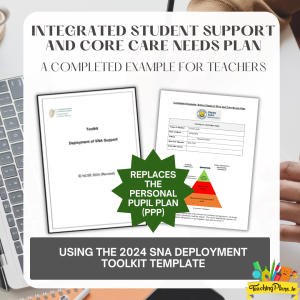
and for a special class here:

The importance of fostering independence
Fostering independence remains a central part of the SNA role.
Circular 0032/2026 states that SNAs should work collaboratively with teachers to encourage and empower students to undertake manageable tasks in line with the individual targets contained in their Student Support Plan. It specifically identifies the development of independent living skills, including toileting, mobility and emotional regulation.
However, promoting independence should not be interpreted as automatically withdrawing necessary support or expecting every student to become fully independent within a particular period.
The level of support must remain sufficient to meet the student’s needs. At the same time, it should be provided in a way that does not unnecessarily restrict the development of the student’s functional and independent living skills. The strategies used and the responsibilities of the adults involved should be set out in the SSP and reviewed regularly.
The focus should therefore be on providing the right support at the right level, while creating meaningful opportunities for the student to develop skills wherever this is appropriate.
Who develops the plan?
The development and review of the Student Support Plan is led by a member of the teaching staff involved in the student’s education (usually the SET).
The process should be collaborative and may involve:
- the class or subject teacher;
- the special education teacher;
- the SNA;
- the principal or SEN coordinator;
- the student;
- parents or guardians;
- relevant outside professionals.
Circular 0032/2026 specifically states that the SNA should be included in the development, implementation and review of Student Support Plans.
SNAs often have valuable knowledge of how students manage routines, transitions, communication and personal-care tasks throughout the school day. Their observations can therefore make an important contribution to planning and review.
The plan remains teacher-led, however, and responsibility for establishing educational and care targets does not transfer to the SNA.
What terminology should schools now use?
The new circular uses:
- core care needs;
- Student Support Plan;
- Student Support File;
- student support duties;
- fostering independence.
Note: The NCSE’s 2024 template uses the term Additional Care Needs rather than Core Care Needs. Unless the NCSE updates this template, schools using the official template may continue to see that heading.
These terms are not necessarily contradictory. “Core care needs” describes the student’s significant or priority care needs under the new circular, while “Additional Care Support” is the heading used in the existing NCSE planning template.
What should schools do now?
Schools should review their current planning procedures for students who access SNA support.
They should follow the most current Department and NCSE guidance while avoiding unnecessary duplication of documents (i.e. creating a Student Support Plan and a separate Personal Pupil Plan).
Existing plans do not necessarily need to be discarded immediately where the school has separate PPP documents complete. Schools can transfer relevant information into the student’s next or revised Student Support Plan as part of the normal review process.
In summary
The publication of the NCSE’s Toolkit on the Deployment of SNA Resources in 2024 marked a move towards integrating care-needs planning into the Student Support Plan.
Circular 0032/2026 has now provided much greater clarity. It supersedes Circular 0030/2014, removes the previous Department requirement for a separate Personal Pupil Plan and explicitly defines the Student Support Plan as an individualised learning and care plan.
Therefore:
A separate PPP is no longer the appropriate Department-prescribed planning document. Where a student has identified core care needs, these should be planned for within the Student Support Plan as part of the wider Student Support File.
This integrated approach should reduce unnecessary duplication while ensuring that the student’s learning, participation, care and developing independence are considered together.
