
Blog
Planning for Social and Environmental Education (SEE): My Experience and What Teachers Need to Know
In 2023, the Primary Curriculum Framework was published. It outlined how History and Geography would be combined to form a new curriculum area called Social and Environmental Education (SEE) as part of the redeveloped Primary School Curriculum.

In 2025 the final subject specifications were published, including the SEE subject specification. Schools are now engaging in a gradual enactment process for the redeveloped curriculum, which will last at least 6 years. For September 2026, schools will choose choose one of the new curriculum areas to begin implementing, as outlined in circular 0067/2025.

As we enter the final term of the 2025/2026 academic year, schools will be deciding on which specification to begin with, and many teachers will be searching for clear guidance on how to approach long-term plans for the redeveloped primary curriculum.
Having recently worked through the process of developing sample long-term recorded preparation for SEE for each class level, I wanted to share my experience, and provide some practical suggestions for teachers and schools navigating the implementation of the new specifications.
First Impressions of the SEE Curriculum Specification

The SEE (Social and Environmental Education) specification is ambitious and future-focused. It brings together history and geography in a more integrated way, with a strong emphasis on:
- inquiry and investigation
- critical thinking
- global learning themes (e.g. sustainability, human rights, equity, democracy)
- real-world connections
However, one thing becomes clear very quickly:
The curriculum is very broad, flexible and open-ended.
This provides opportunities, but it also means that teachers need to make more decisions than ever before!
The Biggest Shift: Planning Without Prescribed Content
One of the most significant changes in the revised primary curriculum is the move away from prescribed content.
In the 1999 curriculum, teachers were given clear options for:
- which historical periods to study
- which people and events to cover
- suggested units of study

With the 2025 SEE curriculum specification, that guidance is no longer provided.
Instead:
- The focus is on broad learning outcomes.
- Schools choose their own content and topics.
- Planning must be developed at a whole-school level, taking account of the context of the school and the interests of the children.
This means schools will need to create a clear and detailed whole school SEE curriculum plan outlining the scope and sequence of content to be covered from Infants – 6th class.
The Reality of Planning in Schools
From my experience (and from speaking to other teachers), many schools are:
- unsure where to start with planning for the new specifications
- overwhelmed by the open-ended nature of the redeveloped curriculum
- wondering how they will ensure progression across class levels
- worried about gaps or repetition
- feeling under pressure to develop a whole-school plan
There is a real risk that schools may default to publisher schemes to fill the gap.
While schemes can be helpful, unless they are used thoughtfully, they may not:
- reflect your specific school context
- align fully with the intent of the Primary Curriculum Framework
- support genuine teacher agency and flexibility
The quality of the training that will be provided by Oide to support the roll out of each specification will be crucial. Schools will need comprehensive, practical support to help them navigate this shift, as they are now effectively being asked to design their own whole school programmes based on the learning outcomes.
This is a significant ask. Many schools are already operating at capacity, and teacher workload and burnout are very real concerns. Without clear support and practical guidance, this aspect of the curriculum reform may prove particularly challenging for schools to implement effectively.
Many teachers will be looking for clear, practical examples of SEE planning, not to replace their professional judgement, but to provide a starting point that they can adapt to their own class and school context.
Editable SEE Sample Planning
To support teachers with this shift, I’ve created fully editable sample SEE plans for Irish primary school teachers across all class levels. These plans provide a clear, practical starting point to help teachers confidently plan within the Primary Curriculum Framework, while saving valuable preparation time.
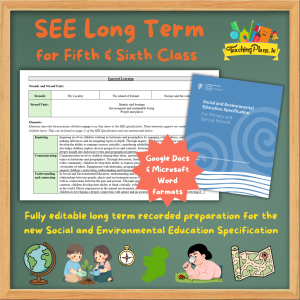
What’s Included:
- Documents pre-populated with all strands, strand units and learning outcomes for each class level.
- A wide bank of playful, age-appropriate and curriculum-aligned learning experiences for each learning outcome, allowing teachers to select what best suits their class.
- Fully editable formats in Google Docs and Microsoft Word for easy adaptation.
- Flexibility to quickly tailor plans to your own class context, school priorities and timetable.
- A clear assessment section aligned with the SEE specification.
- Practical integration suggestions across other curricular areas and whole-school practices/events.
- Suggested classroom routines, culture and longer-term practices that support SEE learning.
- A suggested term-by-term overview to support effective sequencing across the school year.
Basically, they have everything you need to confidently plan for Social and Environmental Education, without starting from scratch!
These plans are not designed to replace teacher professional judgement.
Instead, they are there to:
- provide a clear starting point.
- save you hours of planning time.
- build confidence in working with the SEE curriculum.
- support informed, professional decision-making.
In a context where teachers are being asked to design programmes based on broad learning outcomes, access to high-quality exemplars can provide clarity and reduce workload. These plans are intended to be used as a flexible framework: to be adapted, refined and shaped to suit your own class and school context.
Who These SEE Plans Can Help:
- Schools developing a whole-school SEE plan.
- Irish teachers planning for the revised Primary School Curriculum.
- Teachers looking for clear examples of SEE long term planning.
- Anyone searching for Primary Curriculum Framework planning templates or SEE curriculum planning examples.
SEE Planning FAQs
Do schools have to create their own SEE plan?
Schools will need to make decisions about what topics and content will taught at each class level, and this should be contained in a whole school SEE curriculum policy or plan.
Are there set topics for history and geography?
No. Unlike the 1999 curriculum, the 2025 SEE specification does not prescribe specific topics, time periods or people to study.
Can I use a publisher scheme for SEE?
You can, but it’s important that your planning reflects your own school context and aligns with the intent of the revised primary curriculum.
What is the best way to start SEE planning?
Start with the learning outcomes, then decide on content at a whole-school level. Using sample SEE plans or templates can make this process much more manageable.
Should I have separate plans for History and Geography or one integrated SEE plan?
From Infants – 2nd class SEE is presented as a single curriculum area, and from 3rd – 6th class the subjects of History and Geography become more defined within the specification. However, I feel it makes much more sense to have a single SEE plan for all class levels for two reasons:
- Including History and Geography in the one plan allows you to maximise opportunities for meaningful cross-curricular integration.
- Within the SEE specification, some learning outcomes are common to both subjects at all class levels. Planning together allows these shared outcomes to be addressed in a cohesive and connected way,
Comparing SEE with Another Curriculum Area
I will be completing sample long term plans for all of the new subject specifications in time, and so far I have completed them for SEE and Wellbeing. When I compare my experience with both, I can say with certainty that the SEE specification is much easier to use and plan with!
You can read my full blog post about my experience of creating Wellbeing plans here.

My personal observations of planning for SEE were that:
- The structure of the SEE specification feels more coherent than Wellbeing
- The SEE learning outcomes are easier to interpret than Wellbeing
- There is a natural flow between strands and strand units
- History and geography complement each other well, making integration more straightforward
While SEE is broad, it actually lends itself well to clear, structured planning once you engage with it properly. If I was deciding which of the two curriculum areas to start with for September 2026, I would definitely choose SEE over Wellbeing! I feel that starting with the Wellbeing specification could be overwhelming and schools should build confidence by implementing a more manageable specification initially.
Final Thoughts
Planning for SEE (Social and Environmental Education) is a significant shift from the 1999 curriculum, but it also presents opportunities.
If you’d like to save hours of planning time, and have a clear, structured starting point aligned with the 2025 curriculum specification, you can explore my SEE planning page here.
I’d love to hear your thoughts about the 2025 Social & Environmental Education curriculum specification, or the revised Primary School Curriculum in general in the comments!
