
Blog
Planning for the New Wellbeing Curriculum: An Honest Reflection
In September 2025 brand new subject specifications were published for primary schools in the following areas:
- Wellbeing
- Social and Environmental Education
- Science, Technology, Engineering (and Mathematics Education which was published in 2023)
- Arts Education
- Languages (the Modern Foreign Languages specification is new. The Primary Language Curriculum for English and Gaeilge was published in 2016)
I have spent the past few weeks engaging with the Wellbeing Curriculum Specification, and this post includes some of my thoughts so far.

This new specification represents one of the most significant changes to teaching and learning in Irish primary schools in recent years. It brings together PE and SPHE, places a strong emphasis on child agency, play-based learning, emotional regulation and relationships, and reflects many of the values that teachers already hold at the centre of their practice.
On paper, it is progressive, inclusive and grounded in contemporary research.
In practice, however, planning for the Wellbeing curriculum is far from straightforward.
I have spent the past number of weeks deeply immersed in the specification by reading it, re-reading it, and attempting to create examples of long-term recorded preparation that genuinely aligns with it, I want to share an honest reflection on what I found challenging, what works well, and why many teachers may find this curriculum difficult to translate into day-to-day classroom planning.
A Curriculum with Strong Intent, but Complex Execution
There is no doubt that the intent of the Wellbeing curriculum is sound. The integration of physical, emotional, social and relational learning reflects how children actually experience the world. The move away from rigid content coverage towards learning outcomes developed over time is also welcome.
However, the way the curriculum is structured places a very heavy responsibility on teachers to interpret, translate and operationalise that intent.
Unlike the 1999 curriculum, PE is no longer organised around clear, discrete learning outcomes for each activity area (Games, Dance, Gymnastics, Athletics, etc.). Instead, teachers are presented with broad learning outcomes that are intended to be developed across a range of activity areas.
In theory, this allows for flexibility. In reality, it creates uncertainty.
Most teachers do not plan by saying:
“This week I will develop spatial awareness through dance, athletics and outdoor learning.”
They plan by saying:
“We are doing dance for the next number of weeks.”
This mismatch between how teachers naturally plan and how the curriculum is written will be one of the biggest sources of confusion.
Learning Outcomes Across Two Subjects: Helpful or Overwhelming?
Another major shift is that many learning outcomes are common to both PE and SPHE, while others are subject-specific.
Again, the idea makes sense. Wellbeing is holistic.
But from a planning perspective, this raises very practical questions:
-
Am I “missing” SPHE if the learning outcome is being developed through PE?
-
How do I show balance between PE and SPHE across the year?
Without clear exemplars, many teachers will be left second-guessing themselves.
Progression Is Expected, but Not Clearly Shown
The Wellbeing learning outcomes are designed to be developed over a two-year period, and in many cases they remain identical across multiple class levels.
This places the responsibility for showing progression almost entirely on the teacher:
-
Progression in the language children use
-
Progression in the complexity of experiences
-
Progression in independence, reflection and agency
None of this is wrong, but very little of it is explicitly illustrated in the curriculum documentation.
As a result, planning becomes less about selecting content and more about designing progression from scratch.
That is a big ask, for teachers who are already overwhelmed with constant initiatives, circulars, increasing demands and role expansion.
Inspectorate Guidance vs. Teacher Reality
The 2021 Guidance on Preparation for Teaching and Learning rightly encourages teachers to avoid over-planning and overly detailed schemes.
At the same time, the Wellbeing curriculum offers:
-
no suggested sequencing
-
no term-by-term overview
-
no sample long-term plans
This creates a real tension:
-
Teachers are told not to be prescriptive
-
But are given very little structural support
It is no surprise that many teachers are actively looking for clear, editable sample plans to help them make sense of it all.
Sample Wellbeing Long-Term Plans
After struggling myself to plan coherently for the Wellbeing curriculum, particularly at Infant level, where there is no clear distinction between PE and SPHE, it is clear to me that that teachers will need scaffolding and support in creating recorded preparation.
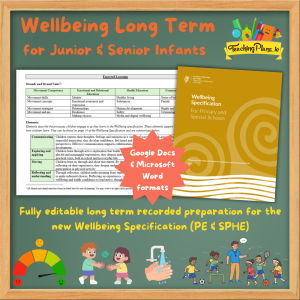
That is why I have created fully editable sample long-term recorded preparation documents for the new Wellbeing specification. These documents are:
-
aligned with the curriculum
-
contain the sections recommended in current planning guidance
-
structured in a way that reflects how teachers actually plan
They include:
-
all strands, strand units and learning outcomes
-
a wide range of suggested learning experiences for PE and SPHE
-
clear acknowledgement that not all learning outcomes need to be fully developed every year
-
guidance notes throughout to support editing and adaptation
They are intentionally designed to be edited, refined and personalised, not followed rigidly. They are pre-populated documents that teachers can quickly adapt to suit their class context, school priorities and timetable, without having to start from scratch, which is exceptionally time consuming.
They are available on our Wellbeing page here.
Final Thoughts
The new Wellbeing curriculum has enormous potential. But it also demands a level of interpretation and planning that many teachers simply do not have time to do alone.
If you find it difficult to plan for Wellbeing, especially long-term, you are not failing as a teacher.
You are responding honestly to a curriculum that is ambitious, values-led, and complex to implement.
If sample planning support would help you save time and feel more confident in your approach, you can explore my editable Wellbeing long-term recorded preparation here. They are there to support your professional judgement, not replace it.
