
Blog
What Does Teacher Planning Actually Need to Include for the 2025/ 2026 School Year?
Over the past few years, teachers in Ireland have been faced with an overwhelming amount of guidance on planning and recorded preparation. From NIPT (Now Oide) and NCCA templates to the 2021 Guidance on Preparation for Teaching and Learning for Primary and Special Schools, it’s no wonder that many teachers feel confused about what exactly they are required to do. Add in the rollout of the new Primary Curriculum Framework (PCF), and the waters get even muddier.
This post will clarify exactly what recorded preparation is required for the 2025/2026 school year and point you towards some practical supports if you’d like to save time and stress with your planning.
Which Curriculum Should Teachers Use in 2025/2026?
One of the most common questions I hear this year is: “Which curriculum should I actually be planning from and using this year?” The answer is:
2019 Primary Language Curriculum (PLC) – for Irish and English

2023 Primary Mathematics Curriculum (PMC) – for Maths

1999 Primary School Curriculum – for all other subjects (SESE, Arts, SPHE, PE.)

The 2023 Primary Curriculum Framework sets out the overall framework for the new curriculum, but most subject areas are still in transition, so for 2025/2026 you are still required to plan from the documents above.
What is Required in Terms of Recorded Preparation?
The Guidance on Preparation for Teaching and Learning (DES, 2021) applies to all teachers — mainstream, special class, SET, and EAL. The key points are:
-
Recorded preparation must be in place for both the long-term and short-term.
-
Your long and short terms should include the following sections:
-
Learning outcomes/ content objectives
-
Learning experiences
-
Assessment strategies
-
Integration (where appropriate)
-
-
Teachers are also required to complete a cuntas míosúil each month.
-
Individual planning (using the NEPS Student Support File template) is used for pupils requiring additional support:
-
Classroom Support Plans (mainstream)
-
School Support and School Support Plus (SET and special class teachers)
-
The emphasis is on clarity and usefulness — your plans should be practical working documents that guide your teaching, not lengthy essays for compliance.
Common Pitfalls in Teacher Planning
-
Over-preparing: Writing far more detail than is required, which leads to burnout.
-
Out-of-date content: Using old templates that don’t reflect the 2021 Guidance or the most recent curriculum documents.
-
Not tailoring to class context: Copying generic plans without adapting them to the needs of your pupils.
-
Neglecting assessment: Skipping clear links between assessment strategies and learning outcomes.
Practical Tips to Streamline Your Planning
-
Use templates aligned with current requirements – this saves time and ensures you’re compliant.
-
Keep it concise – focus on clarity over volume.
-
Leverage digital tools – from editable Word templates to AI tools like ChatGPT, there are lots of ways to reduce workload.
-
Plan collaboratively where possible – agree common structures at school level to avoid duplication.
Upcoming Webinars – August 2025
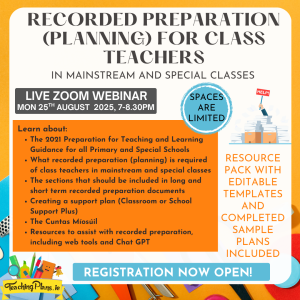
If you’d like step-by-step clarity on what recorded preparation should look like — with examples, editable templates, and time-saving tips — join me for my upcoming live webinars:
-
Monday 25th August (7–8.30pm): Class Teacher Recorded Preparation (Mainstream and Special Class). Register here.
-
Wednesday 27th August (7–8.30pm): SET and EAL Teacher Recorded Preparation. Register here,
Each webinar comes with a comprehensive resource pack worth over €30, including editable templates, completed examples, the webinar slides, and a certificate of completion. A full recording will also be available to all registrants.

Planning Bundles Updated for 2025/2026
All of my sample planning bundles on TeachingPlans.ie have been fully updated to reflect the requirements for the 2025/2026 school year. This means you can download plans that are already aligned with the correct curriculum documents, the 2021 Guidance, and the Primary Curriculum Framework.
If you want to save time while still ensuring high-quality, compliant plans, you can browse the full range of updated planning bundles under the “CLASS LEVEL” menu at the top of the page.

Final Word
Teacher planning doesn’t need to be overwhelming. By focusing on the actual requirements — not the myths or the outdated practices — you can save hours of unnecessary work while still producing clear, useful, and professional plans.
If you’d like a guided walkthrough and ready-to-use resources, I’d love to see you at one of my August webinars.

Aside from long terms, short terms, CM etc, what else is required? Assessment folder? Containing how much?!Thank you so much
Hello, thanks for your comment.
In the 2021 Guidance on Preparation for Teaching and Learning for All Primary and Special Schools, the only specific recorded prepration documents it describes are long-terms, short-terms, and the Cuntas Míosúil. Your principal will also likely require a timetable, and inspectors would expect to see one if they visited.
Assessment is outlined in both the Guidance and the curriculum documents themselves as being integral to preparation for teaching and learning. But it isn’t about keeping a certain “amount” of assessment records, but rather about ensuring that assessment serves a clear purpose:
Assessment for Learning (AfL): Ongoing assessment to identify strengths, needs, and gaps in children’s learning so that you can adapt teaching accordingly.
Assessment of Learning (AoL): Used after teaching to evaluate progress and establish whether learning outcomes have been met.
Assessment as Learning (AaL): Encouraging pupils to reflect on their own learning and set goals for improvement.
The form your assessment folder takes can vary from teacher to teacher. It could even be in digital only format. Many teachers include examples of checklists, pupil work samples, test results, and notes from observations or conferencing. The key is to show how assessment information is used to inform planning and teaching, rather than just collecting data for the sake of it!
I hope that helps!
Claire